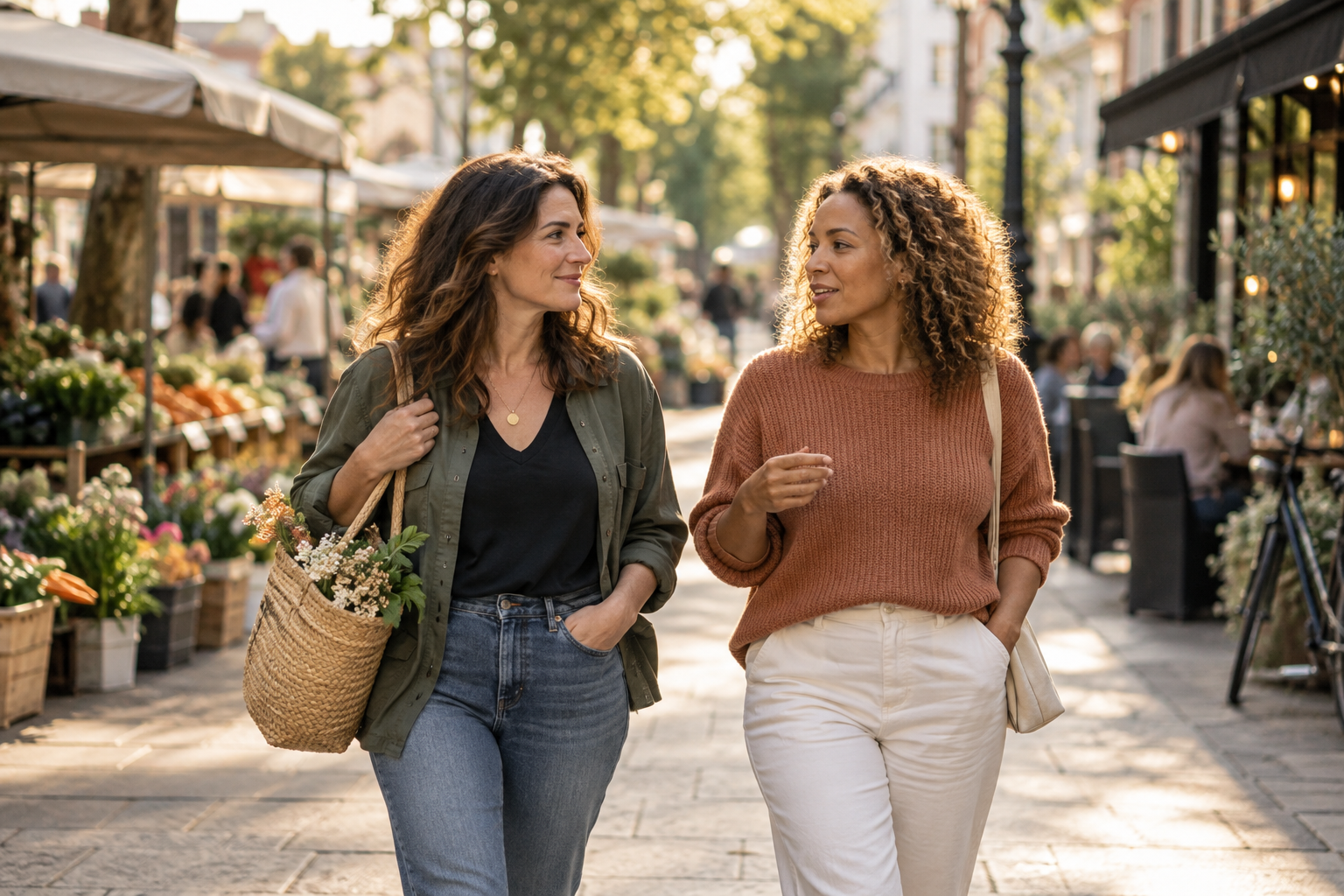
I don’t actually have much trouble meeting people. I can walk down the street and know people to stop and talk to. I can walk into a pub and know the majority of the people there. We can sit together, have proper conversations, laugh and genuinely enjoy each other’s company.
Then we go home. Nobody necessarily texts the next morning. There may be no plans for the following weekend. We’ll probably see each other again, but only when we happen to find ourselves in the same place. That’s the difference I’ve started to notice as I’ve got older. I know plenty of people. That isn’t quite the same as having plenty of good friends.
I would still call many of those people friends. Describing them as acquaintances seems unnecessarily dismissive when I’ve known some of them for years and genuinely like them. But there are clearly different levels of friendship, even if we use the same word for all of them. I have a slightly ridiculous test for this: if someone told me I was going away with this person for a few days and we’d be sharing a hotel room, how would I feel? There are people I happily call friends who would have me reconsidering the classification fairly quickly.
So perhaps making friends after 40 isn’t always difficult because we can’t meet people. The harder part is turning someone we know and like into someone who becomes part of our actual life.
Friendship used to happen without so much organising
Most of my close friends are people I met when I was young. Some are from school and others came from an after-school job. I don’t think that’s because I stopped meeting people I liked as I got older. I think it’s because when I was younger, I didn’t have to arrange friendship in quite the same way.
You could meet someone once and suddenly be best friends. You had fewer restrictions on your time, but you were also repeatedly ending up in the same places. You saw each other at school or work. Most people of the same age in an area were going to the same places at the weekend. If you met someone you liked on Saturday night, there was a reasonable chance you’d both be in the same place the following Saturday. Nobody had to make much effort to ensure you met again.
It turns out all those hours matter. Research into friendship formation has found that it can take roughly 40 to 60 hours together to move from acquaintance towards friendship, and considerably longer to develop a close friendship. When you’re young, you can accumulate that sort of time without noticing. You might see someone five days a week before you’ve ever deliberately arranged to see them.
Try accumulating the same amount of time with someone new in your 40s and it looks rather different. A coffee here, a night out three weeks later, another plan that gets postponed because one of you is busy. Months can pass while both people genuinely intend to see more of each other.
And being single with no children doesn’t somehow leave you with an empty diary. There is still work, family, existing friends, appointments, responsibilities and everything else that fills an adult life. The other person has all of those things too, possibly with a partner and children added in. Two people can genuinely want to meet and still somehow spend six weeks trying to find a Thursday that suits them both.
Our oldest friends also have something that no new person can offer us: history. I sometimes wonder how many people who have been close friends for 20 or 30 years would actually become friends if they met for the first time at 40. Perhaps one would think the other was too loud, too quiet or simply not her type of person.
But they didn’t meet at 40. They met years ago, and everything that has happened since has become part of the friendship. They remember the people each other used to be as well as knowing the people they’ve become. There are stories they’ve told so often nobody else would find them funny anymore, difficult periods they went through together and ordinary years that somehow added up to a shared history.
By the time we reach our 40s, many people already have those relationships, sometimes several different groups of them: school friends, work friends, neighbours, other parents, people they go out with. They’re often already struggling to find enough time for the friends they have. It isn’t necessarily that people become less open to friendship as they get older. Sometimes a new person is simply arriving in a life that already feels full.
Being around people isn’t enough
This is where the standard advice about making friends starts to irritate me slightly: get a hobby.
I understand why people say it. If you join something, you’ll repeatedly meet people with at least one shared interest, and that gives friendship an opportunity to develop. If you genuinely want to take up tennis or join a running club, it probably makes perfect sense.
Unfortunately, I don’t like sports and couldn’t run the length of myself if I tried. I’m fairly sure my teammates would be more interested in finding a replacement for me than becoming my new best friends.
And what if you genuinely don’t have a hobby you want to pursue? If I force myself to take up something I have no particular interest in purely to meet people, I’m not convinced I’ve found people with similar interests. They actually like the activity. I’m there because apparently this is how the internet has decided adults make friends.
That’s not to say classes, clubs and hobbies don’t work. Of course they do. But they only solve the first part of the problem: putting people in the same place. I learnt through work that being in the same place can create very real friendships, but it can also hide how much the place itself is helping to hold them together.
I spent ten years in my last job, and I thought I had made friends there who would be in my life permanently. At the time, there was no reason to think otherwise. We spent our days together, knew what was happening in each other’s lives and genuinely cared about one another.
I’ve been gone for about a year now. I still speak to some of them, but some of the messages have already become less frequent. I can imagine that, with some people, they may eventually become an annual happy birthday or happy Christmas message. That doesn’t make me think those friendships were fake. They were real. I just hadn’t appreciated how much seeing each other every day was helping us stay close. We didn’t have to find time for each other because work had already done it for us.
Texting makes it possible to keep some contact without seeing each other, and that’s obviously useful. But staying in contact with somebody isn’t necessarily the same as staying close to them. If months are passing and most of the relationship has become occasional words on a screen, something has changed even if neither person deliberately changed it.
Perhaps that’s why meeting people has never felt like the hardest part to me. I meet people. The difficult part is what happens after you’ve met.
Somebody has to make the next thing happen
One of the closest friends I’ve made in recent years came from a pub I was already going to. I knew people there and would happily sit talking to them, but I wasn’t arranging to meet any of them. I saw whoever happened to be there on the night.
Then one woman asked for my number. She said she’d text me the next time she was going out, and she did. For whatever reason, I said no the first couple of times she asked. The third time she invited me, I was genuinely sick. I remember saying to my brother that I thought I needed to go anyway. If somebody asked me out three times and I said no three times, she would be perfectly entitled to stop asking.
So I went, and we’re now very good friends. I’ll probably never know why she made such an effort to include me, but I’ll always be grateful that she did. She could easily have continued chatting to me whenever we happened to be in the same place. Instead, she made sure there would be a next time.
There is an uncomfortable part of that story for me too. I could have been saying that I wanted more good friends while repeatedly declining invitations from somebody who was trying to become one. I wasn’t deliberately rejecting the friendship. I just hadn’t reached the point where seeing her felt important enough to organise my life around.
That’s one of the strange things about making a new friend as an adult. We make time for our existing friends because we already know what they mean to us. With someone new, you have to give the relationship some of that time before either of you knows whether it will become important. Somebody has to make an effort at the stage when there’s no guarantee the effort is going anywhere.
It doesn’t help that adults can be incredibly enthusiastic about plans until the plans require an actual commitment. Anyone who has ever tried to organise a bus for a group of people will understand this. On day one, twenty people want to go and everyone is delighted with the idea. Then you ask for a deposit. Suddenly people aren’t sure. They’ll have to check. They’ll let you know.
Before long, you’re no longer looking for a bus. You’re trying to find a taxi for yourself and the two people who are still coming.
Friendship can suffer from the same problem. We should definitely do something is easy. Choosing a day and actually turning up is where it becomes real.
Maybe we don’t need to start with strangers
There are now friendship apps, organised meet-ups, group trips and events specifically for adults who want to meet new people. I seem to see more and more of them, and clearly there are plenty of people who want exactly that. I’m fairly certain I wouldn’t go to one alone, though. People who know me probably wouldn’t describe me as shy, but when I don’t know anyone, I’m horrendously shy and awkward. I’ve been told before that the awkwardness can make me appear snobbish, which is unfortunate when the entire purpose of the exercise would be convincing strangers that they might like to spend more time with me.
I don’t think I’d use a friendship app either. I’m too cautious about how easily people can present themselves differently online, and I don’t think I’d ever completely put my guard down. Other people will feel completely differently, and for someone who has moved somewhere new or genuinely knows nobody, those options may be invaluable. But if I suddenly had to make more friends, I don’t think that’s where I’d begin. I’d start with the people I already know.
There are people we repeatedly have good conversations with but never make plans with. Former colleagues we genuinely miss. People we always enjoy seeing when we bump into them. People we’ve been saying “we must do something” to for years without either person ever suggesting what that something might be.
Maybe before asking where we can meet new people, it’s worth asking whether there is anybody we already know whom we’d like to know better. It removes at least some of the uncertainty. You already know you can hold a conversation. You know you don’t dislike each other. Nobody has to walk alone into a room full of strangers or develop a sudden passion for pottery just to meet people.
Of course, there’s still an awkward bit. Somebody has to suggest doing something outside the place where you normally meet. Somebody has to send the message first. And there is something strangely vulnerable about admitting you want more friends.
Nobody thinks it’s unusual for a single person to say she’d like to meet a partner. There are apps, events and entire industries built around helping her do exactly that. Saying you’d like to make a new close friend can somehow feel more embarrassing, as though friendship is something we were supposed to have sorted out years ago.
But lives change. People move away. Jobs end. Friendships fade. Other people’s lives become busier. Sometimes we simply realise that knowing lots of people isn’t giving us quite the same thing as having a few people we can really depend on.
For those of us who don’t have a partner or children at home, friendship can also provide some of the everyday companionship that other people may find within their household. It isn’t something that should be squeezed into whatever space is left after the relationships society considers more important. It can be one of the relationships around which a life is built.
Perhaps making friends after 40 is difficult partly because life no longer does enough of the arranging for us. When we were younger, it kept putting us back in the same places until some of the people there became important. Now we can meet somebody we genuinely like and still never create enough opportunities for anything more to happen.
My friend changed that by asking for my number and making a plan. I nearly made sure it went nowhere by saying no.
And occasionally, when somebody asks us for the third time, we have to recognise that perhaps we should say yes.