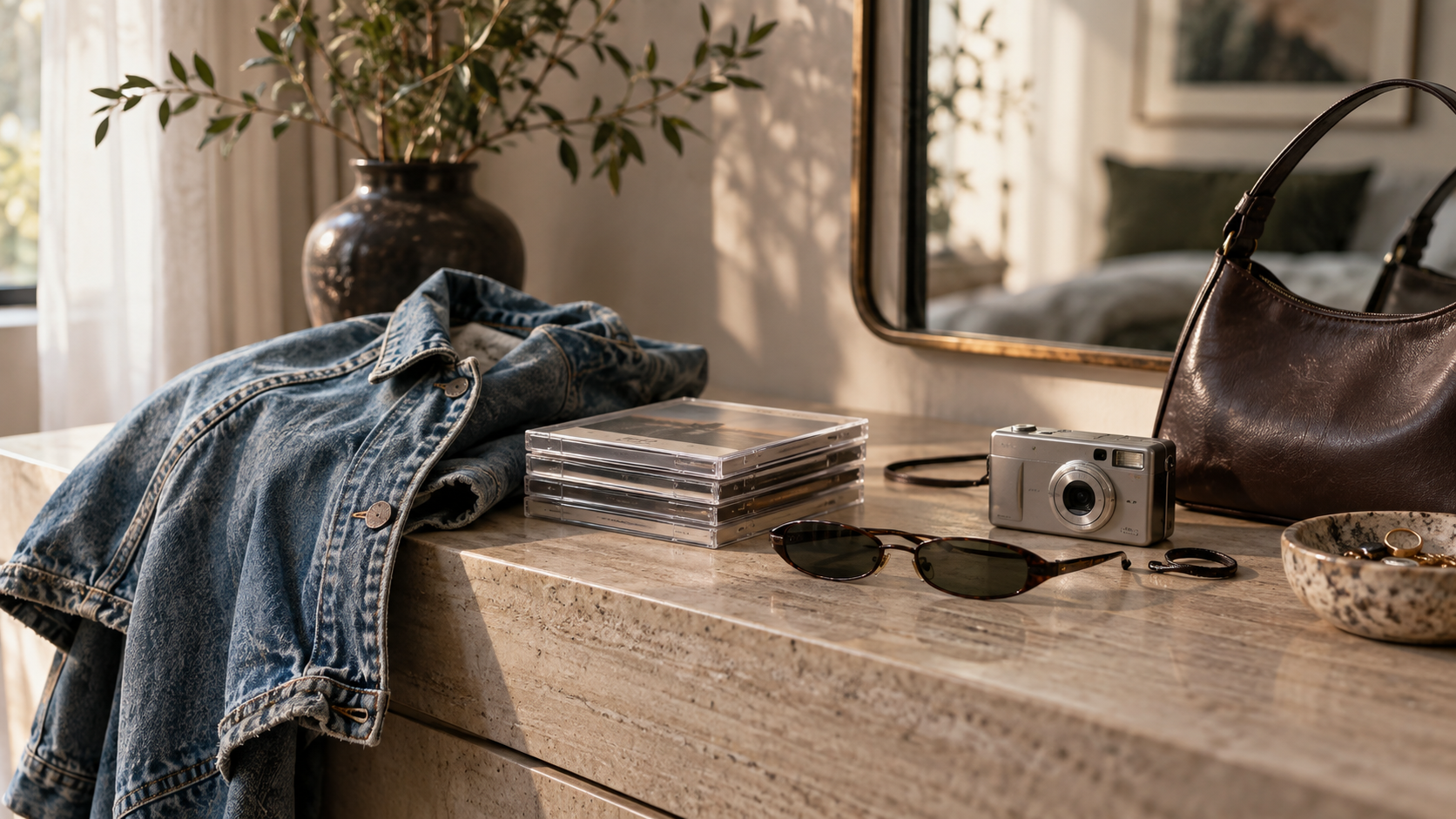
There comes a moment in adult life for which nobody adequately prepares you.
Something you remember buying new becomes vintage.
Not vintage-inspired.
Not retro.
Actual vintage.
You see a jacket, a handbag, a piece of furniture or some piece of technology described as a vintage 90s find, and your immediate reaction is:
No.
Vintage is old.
The 90s were only…
And this is usually the point at which it’s best not to finish the calculation.
Because unfortunately, the 90s are vintage.
I don’t like it either.
I remember when this happened the first time
When I was younger, my mother would occasionally see something that was fashionable and tell me she’d worn the same thing years before.
Fashion comes back around. Everybody knows this.
At the time, though, I was experiencing the new version. Whatever I was wearing wasn’t retro to me. It was just what was in the shops.
Then enough time passed for fashions I remembered the first time to start coming back again.
What’s even more alarming is that we’ve now been doing this for long enough that some people are seeing fashions from their youth come back for the second time.
They wore something when it was fashionable. Watched another generation revive it years later. And now here it comes again.
At some point I’m not sure we can keep calling this a comeback.
It’s doing laps.
Nostalgia is now a genuine force in retail. Circana reported in 2026 that it’s influencing spending across multiple categories, including among younger shoppers buying into periods they didn’t necessarily experience themselves. YouGov has found the 90s particularly fashionable among Gen Z.
Which is lovely.
I’m glad everyone had a meeting and decided our old clothes were good after all.
I just wish we’d been informed before we threw them away.
Some things can come back. We need to discuss the jeans.
Fashion revivals are selective, of course.
Sometimes something comes back and you wonder why we ever stopped wearing it.
Sometimes you see it and think, Oh yes. I remember those.
And occasionally something reappears that makes you realise society has failed to preserve an important historical lesson.
Low-rise jeans, for example.
I’m not objecting to low-rise jeans in general.
I’m talking about the ridiculously low ones.
People who weren’t there may not fully appreciate how committed we became to lowering a waistband. There was a period when jeans seemed to be engaged in a competition to see how far down they could go while still technically qualifying as trousers.
Every year, another inch disappeared.
Eventually there was nowhere left to go.
Those can stay in the past. We pushed that particular experiment far enough.
It isn’t just the clothes
Perhaps clothes coming back shouldn’t feel particularly strange. Fashion has always recycled itself.
It’s when ordinary objects from your life start acquiring words like vintage, retro and collectible that things become more unsettling.
CDs, for example.
There are people buying CDs because they like physical media. Vinyl has been back for years. Film photography has become desirable again. Digital cameras from the 2000s have found enthusiastic new audiences.
The digital camera one is particularly difficult to process.
Because some of us remember when the digital camera was the thing replacing the old technology.
It was modern.
It was exciting.
You could take a photograph and see it immediately.
No film. No waiting. No picking up an envelope of photographs several days later and discovering that someone’s eyes were closed in the only picture you took.
And now old digital cameras themselves can be retro.
Apparently technology can become obsolete, survive the embarrassment and eventually emerge from the other side as interesting again.
This suggests we should probably stop throwing anything away.
That drawer full of unidentified cables may yet fund your retirement.
The maths is extremely unhelpful
There’s a fact about all this that I would strongly recommend not thinking about.
In 1986, 1946 was forty years earlier.
In 2026, 1986 is forty years earlier.
I understand the arithmetic.
I reject the conclusion.
Because mentally those two distances do not feel remotely equivalent.
Looking back from the 80s to the 1940s felt like looking back into history.
The clothes were old. The cars were old. The photographs looked old. The world seemed visibly different.
The 1940s could comfortably be described as vintage without causing any emotional difficulty whatsoever.
The 80s?
That’s different.
I remember the 80s.
Of course, to someone young enough, anything beginning with 19 probably looks historical.
I understand their position.
I don’t care for it.
Apparently, somewhere in my head, vintage has always meant from before I can remember.
This worked perfectly well until vintage caught up with me.
Nobody tells you this when you’re young. You assume old things will remain conveniently behind you while you continue occupying the present.
Then one day the present moves on without consulting you and puts a price tag on something you remember buying new.
Vintage.
Excuse me?
It’s only going to get worse
The really unfortunate part is that the nostalgia cycle isn’t stopping at the 90s.
We’ve already had enormous interest in Y2K fashion and culture, and fashion coverage has begun discussing a revival of the 2010s.
The 2010s.
I had just about accepted that the 90s were vintage when somebody announced that the 2010s were coming back.
Absolutely not.
Some of my things from the 2010s haven’t even broken yet.
Perhaps this is simply what happens once you’ve accumulated enough decades. You stop experiencing fashion and culture as a straight line and start recognising things as they come back around.
The first time, it’s new.
The second time, it’s a revival.
By the third time, presumably you just nod.
Oh, we’re doing this again.
And there is something quite nice about younger people finding things from another generation and deciding they’re worth having. They don’t have to remember the first version to enjoy the next one.
I’m trying to be mature about it.
The 90s are vintage.
Fine.
The clothes can come back. The CDs can come back. The cameras can come back. Apparently some of the furniture is coming back too.
I’ll accept all of it.
But those extremely low-rise jeans can remain exactly where we left them.
We’ve already done our time.
Sources / Further Reading
Circana — Yesterday’s News, Today’s Trends: How Nostalgia Is a Multi-Category Driver. Research on nostalgia influencing consumer purchases across categories and generations, including younger consumers buying into eras they did not personally experience.
YouGov — Gen Z Says the ’90s Were Peak Style. Survey research examining attitudes toward fashion decades, with the 90s particularly popular among Gen Z respondents.
Vogue — Why Fashion Still Loves the ’90s. Discussion of the continuing influence of 90s nostalgia and fashion rather than its disappearing after a single trend cycle.
The RealReal — 2026 Resale Report. Resale-market evidence on younger consumers, vintage fashion and what the company describes as “new nostalgia.”
Vogue — Are We Officially Entering a 2010s Revival? Coverage of fashion’s nostalgia cycle beginning to revisit styles from the 2010s.