Cooking for one should be the easiest version of cooking.
One person. One appetite. No children announcing that the food they happily ate last Tuesday is now disgusting. No negotiating over mushrooms. No making three slightly different versions of the same dinner because apparently sauce touching rice is a problem.
And yet cooking for one is weirdly difficult.
Not technically difficult. I am capable of dividing a recipe by four. It’s everything around the cooking that doesn’t divide quite so neatly.
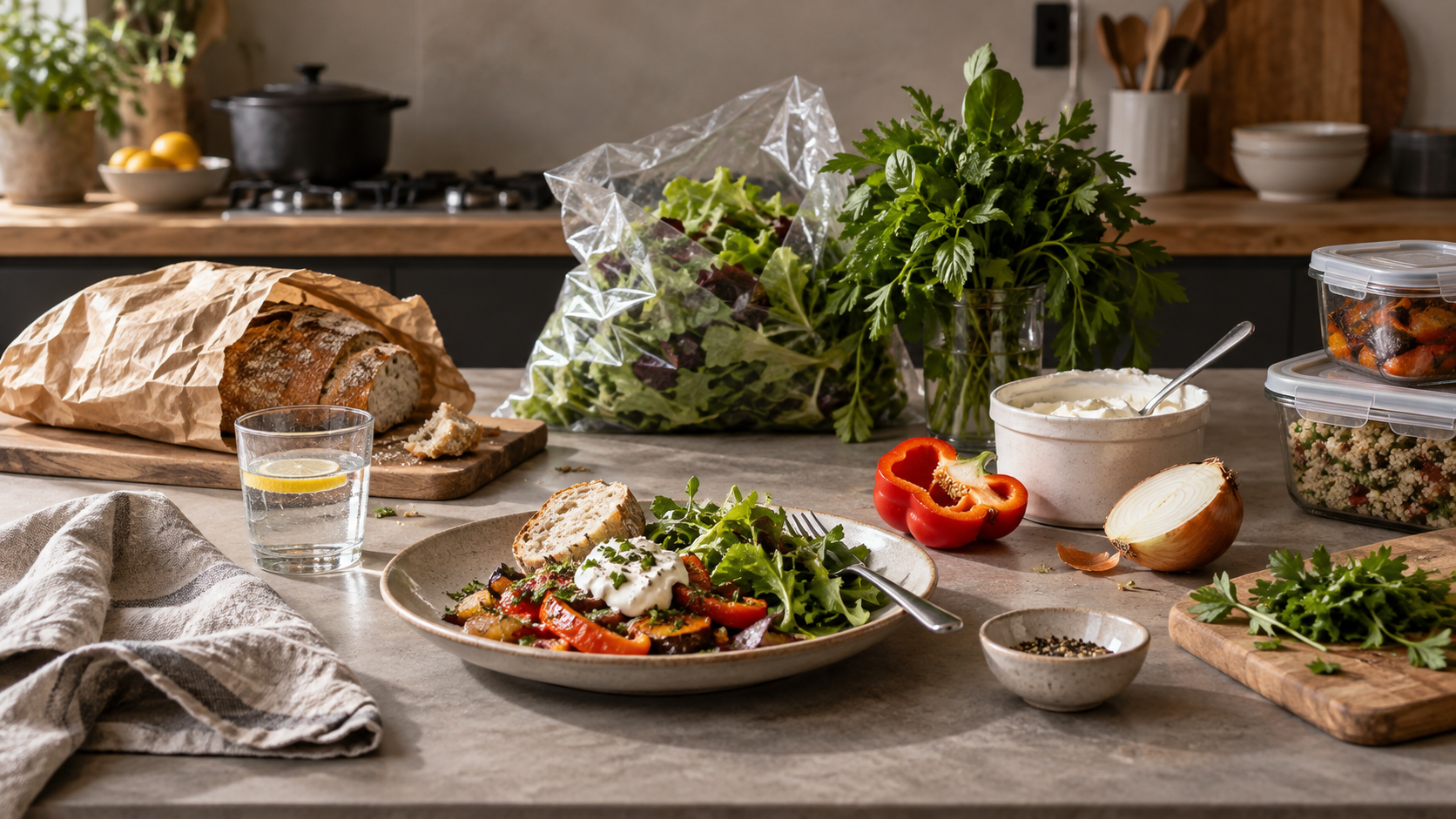
The loaf of bread. The bag of salad. The bunch of herbs you needed approximately six leaves from. The packet that says “serves four” as though you’ve invited three people over and forgotten about them.
Cooking for one isn’t really one problem. It’s shopping for one, storing for one, portioning for one and somehow getting through everything you bought before it starts developing its own ecosystem.
And it turns out this isn’t just poor fridge management.
Food isn’t really sold for one
A lot of the food we buy still assumes there is somebody else at home.
Recipes are routinely written for several people. Pack sizes are designed around households. Offers reward buying more. The larger version is often considerably better value per gram than the smaller one.
Which creates one of the stranger calculations of shopping for one: do I buy the amount I actually need, or the amount that makes financial sense?
Bread is possibly the perfect example.
At the time of writing, Tesco Ireland was selling a 390g Brennan’s half loaf for €1.79. An 800g loaf from the same brand’s Super Bread range was €2.29. They’re not identical products, so it isn’t a perfect price comparison, but they illustrate the problem rather beautifully.
For another 50 cent, you can have roughly twice as much bread.
Excellent value. Assuming you need twice as much bread.
If you don’t, your choices are to pay considerably more per kilo for the smaller loaf, buy the larger one and become unexpectedly committed to toast, freeze half of it, or watch several slices slowly become building materials.
And bread is hardly alone. Fresh herbs seem to be sold exclusively to people opening a restaurant. Salad has an extraordinarily brief period between I should eat more salad and what is that liquid at the bottom of the bag? A recipe asks for half a pepper, a spoonful of crème fraîche or 100ml of something sold in a 500ml container.
None of these is a catastrophe. That’s partly why it’s so annoying. It’s just a constant low-level logistical problem created by having one mouth instead of several.
And yes, we really do waste more
There is evidence that smaller households have a harder time with this.
Research across different countries has found that people living alone can waste more food per person than those in larger households. A 2026 European meta-analysis found household structure had a measurable relationship with food waste and pointed to UK evidence that single-person households produce more waste per person, often because food isn’t eaten before it goes off.
A 2024 Finnish study found the same pattern. The 165 one-person households in the study generated significantly more avoidable food waste per person than two-, three- and four-person households. They also got through more food packaging per person.
More recent research into food waste and packaging suggests why buying the “right” amount isn’t necessarily straightforward. Single-person households are particularly vulnerable to the trade-off between buying larger quantities that may not get eaten and buying smaller, packaged portions that come with their own financial and environmental costs.
In other words, sometimes the sensible choice isn’t particularly obvious.
Ireland has also produced one statistic that feels almost suspiciously relevant to my kitchen: in 2026, 48% of people surveyed by the Environmental Protection Agency said bread was the food they threw away most often.
Of course it’s bread.
Somewhere, a half loaf is feeling vindicated.
The solution is always apparently “meal planning”
Advice about cooking for one tends to assume that the problem can be defeated with sufficient organisation.
Plan your meals. Write a shopping list. Batch cook. Freeze individual portions. Use your leftovers creatively.
All of which works. It is also how your freezer ends up containing eleven anonymous containers which you were absolutely certain you would recognise later.
Batch cooking is probably one of the most sensible answers to cooking for one. Make four portions, eat one and freeze three. Future You gets a homemade dinner with almost no effort.
Future You should be delighted.
Unfortunately, Future You occasionally turns out to be an ungrateful cow who doesn’t want chilli again.
That’s the bit meal plans can’t entirely solve. Food isn’t just fuel that can be allocated efficiently across seven boxes marked Monday to Sunday. You can plan lentil curry for Thursday and reach Thursday with absolutely no interest in lentil curry.
Plans change. Someone asks you out for dinner. You work late. You aren’t hungry. You are hungrier than expected. The avocado goes directly from masonry to compost without passing through the edible stage.
The more people in a household, the more opportunities there are for someone to eat the thing that needs eating.
When there is only one of you, that’s your job.
Again.
Then there’s the effort-to-dinner ratio
Some meals make perfect sense for one. Eggs. Pasta. A stir-fry. Things that can go from vague intention to plate without requiring project management.
Others feel slightly absurd.
There is something difficult to justify about spending hours preparing a meal that will take one person eight minutes to eat. Slow cooking something for four hours so that five people can demolish it in ten minutes is bad enough. When the entire audience for those four hours of culinary effort is you, the effort-to-applause ratio becomes considerably worse.
This may be why “cooking for one” advice so often becomes “cook for four anyway.”
Which brings us back to the freezer.
Perhaps the problem isn’t that we’re bad at this
There is a temptation to make food waste a personal failing. If we’d planned better, stored things better, frozen things sooner and remembered the half an onion behind the yoghurt, none of this would have happened.
Some of it wouldn’t.
But there is a structural problem too. Food packaging, recipe quantities and supermarket economics don’t always shrink neatly to fit a household of one. Even official guidance on reducing food waste has recognised the need for portion and package sizes that work for different household sizes.
That leaves people cooking for one with a slightly ridiculous set of choices.
Buying more can be cheaper. Buying less can mean paying more per gram. Buying fresh means using it quickly. Buying frozen solves some of the problem, but eventually your freezer starts exercising an unreasonable amount of editorial control over what you’re having for dinner.
There isn’t always a perfectly efficient choice.
And perhaps that’s worth remembering the next time you find yourself throwing away half a bag of something you genuinely intended to eat.
What actually makes it easier?
The boring answers are, unfortunately, mostly the right ones.
Freezing bread works. Buying loose fruit and vegetables helps when they’re available. Ingredients that can become several genuinely different meals are easier to get through than something bought for one specific recipe. Freezing extra portions while you still like the food is considerably more successful than doing it on day four when you never want to see it again.
But perhaps the most useful adjustment is to stop assuming that the larger pack is automatically better value.
The cheapest price per kilo isn’t cheaper if part of the kilo ends up in the bin. That’s a surprisingly difficult habit to break because we’ve been trained to recognise the bigger pack as the bargain.
Sometimes it is.
Sometimes you’re just buying your bin dinner.
Cooking for one has advantages. You can eat exactly what you want, when you want it. Nobody complains about the mushrooms. Nobody asks what’s for dinner while you’re visibly making dinner.
But it requires a peculiar amount of planning for something involving only one person.
You buy the food. You cook the food. You eat the food.
And occasionally you pay someone to take away the bit you couldn’t get to in time.
Still, there is always another solution.
Get a dog.
Sources / Further Reading
Houlihan & Williams — Food Waste in European Households: A Meta-Analysis of Behavioural Drivers and Quantitative Trends
2026 meta-analysis examining household food waste across Europe, including the relationship between household composition and waste per person.
Närvä, Alarinta & Wirtanen — The Amount of Food Waste and Food Packages Generated in Various-Sized Households
2024 study comparing food and packaging waste across different household sizes, including one-person households.
Avoidable Food Waste and Household Size: A Life Cycle Comparison of Packaged and Unpackaged Fruits and Vegetables
2025 research examining the trade-off between packaging and food waste and the particular challenges facing single-person households.
Environmental Protection Agency — Bread Is the Food Thrown Out Most Often at Home
2026 Irish research into household food-waste habits, including bread waste and freezing behaviour.
Oklahoma State University Extension — Cooking for One or Two
2026 guidance addressing the practical difficulties created by recipes and food packages designed for larger households.